ENVIRONMENTAL EDUCATION: CONECTA PROGRAMME
At the Foundation, we are committed to carrying out formal and non-formal actions to raise awareness of the environment with the aim of restoring the system of relationships between people and the natural environment. We want to promote sustainability through a change in ecological awareness, which implies a change in our habits, skills, attitudes, sensitivities and behaviours.
We believe in the importance of a conscious population that respects the world we live in, including each other and the natural environment with all its resources. Creating this awareness is the cornerstone of any medium and long-term change we want to bring about in our system. Therefore, for the Foundation it is a fundamental and transversal line of action that must be present in one way or another in all our activities.
In 2021, the Canarina Foundation is launching “CONECTA”, a socio-educational pilot programme conceived as a series of objectives and actions based on environmental awareness and communication to create networks for the social transformation of the community in favour of the eco-social transition.
It is a programme that starts at the school but involves everything around it and seeks to implement strategies to promote environmental awareness among the residents of the neighbourhoods in which it is developed.
The project uses a participatory methodology based on dialogue-based learning with the educational community and inclusive practices to achieve efficiency, equity and social cohesion at the same time, adapting to the reality of the different stakeholders in the neighbourhood and taking into account the different sectors of the population: Children, young people, citizens in general, the commercial and catering sector and local groups and associations.
The CONECTA programme includes several main areas of action:
1. Development of didactic workshops on environmental topics in schools.
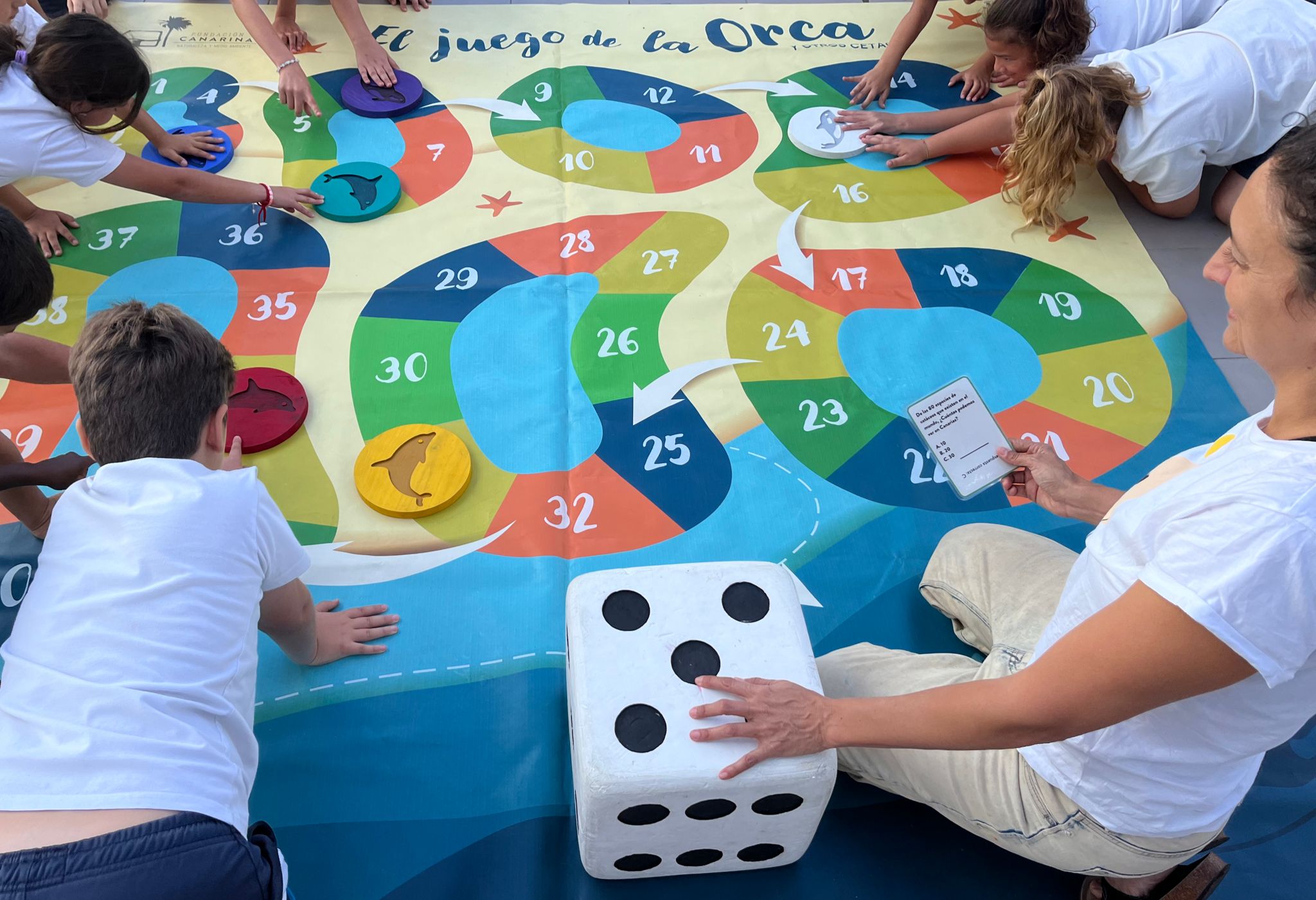
Since 2021, we have been creating and expanding our own catalogue of leisure, educational and creative activities that address environmental values or topics such as Canarian biodiversity and animal welfare.
2. Project for the renaturalisation of schoolyards "PATIOS VIVOS".
Education can play a key role in the renaturalisation of schools, which goes beyond decorating their playgrounds with plants and benches. It is about integrating and opening up their environments to welcome biodiversity, responding to the vital needs of a childhood that is also diverse.
The link with nature has numerous cognitive, emotional, social and physical benefits. In living playgrounds, children find a space to express themselves, learn to coexist with other species and build community through mutual care.
Renaturalising involves the transformation of vacant spaces into green areas with native vegetation, through the participation of the entire educational community (students, families and school staff). This allows students to cultivate curiosity, respect and understanding of natural processes. This project has the potential to generate a positive, significant and lasting impact on schools beyond our intervention.
3. Project to create a network of eco-efficient schools "ECOCENTROS EN RED".
If we want to bring about change in students and make them truly internalise environmental concepts and values, it is essential to ensure that what we teach them and the way schools work, which should be exemplary in terms of sustainability, are aligned. For this reason, this project carries out audits in schools, assessing aspects such as water and energy consumption, waste management and material use. The results of these assessments are revealing, as they show that the vast majority of schools do not meet the basic standards for efficient management of their resources. In addition to carrying out eco-audits and drawing up specific action plans for each school, teachers and non-teaching staff at participating schools receive sustainability training.